

Can home services companies license their records for AI training?
AI data licensing for home services companies lets HVAC, plumbing, and electrical firms grant an AI buyer defined rights to use a carefully scoped copy of dispatch logs, call records, and job history while keeping their original records. Start by checking your rights, customer privacy, and consent. A buyer, eligibility, payment, or outcome is never guaranteed.
A completed job can show more than the repair itself: what the customer reported, why a technician was dispatched, what the technician found, and whether the fix held. Before any records move, the company and buyer need to agree on scope, permitted use, security, retention, and deletion.
Business Nitrogen provides strategic and commercial support and is not a law firm. This page is educational and is not legal, tax, financial, privacy, security, or compliance advice. Calculator results are illustrative licensing estimates, not appraisals, buyer offers, or guarantees. Buyer demand, eligibility, timing, terms, and payment are not guaranteed. Consult qualified advisers before licensing or transferring data.
I’m David Asarnow, Founder and Head of Strategy at Business Nitrogen, with more than 35 years of experience building and scaling businesses. I approach AI data licensing for home services companies as a business decision that starts with what records you have and what you have the right to share.
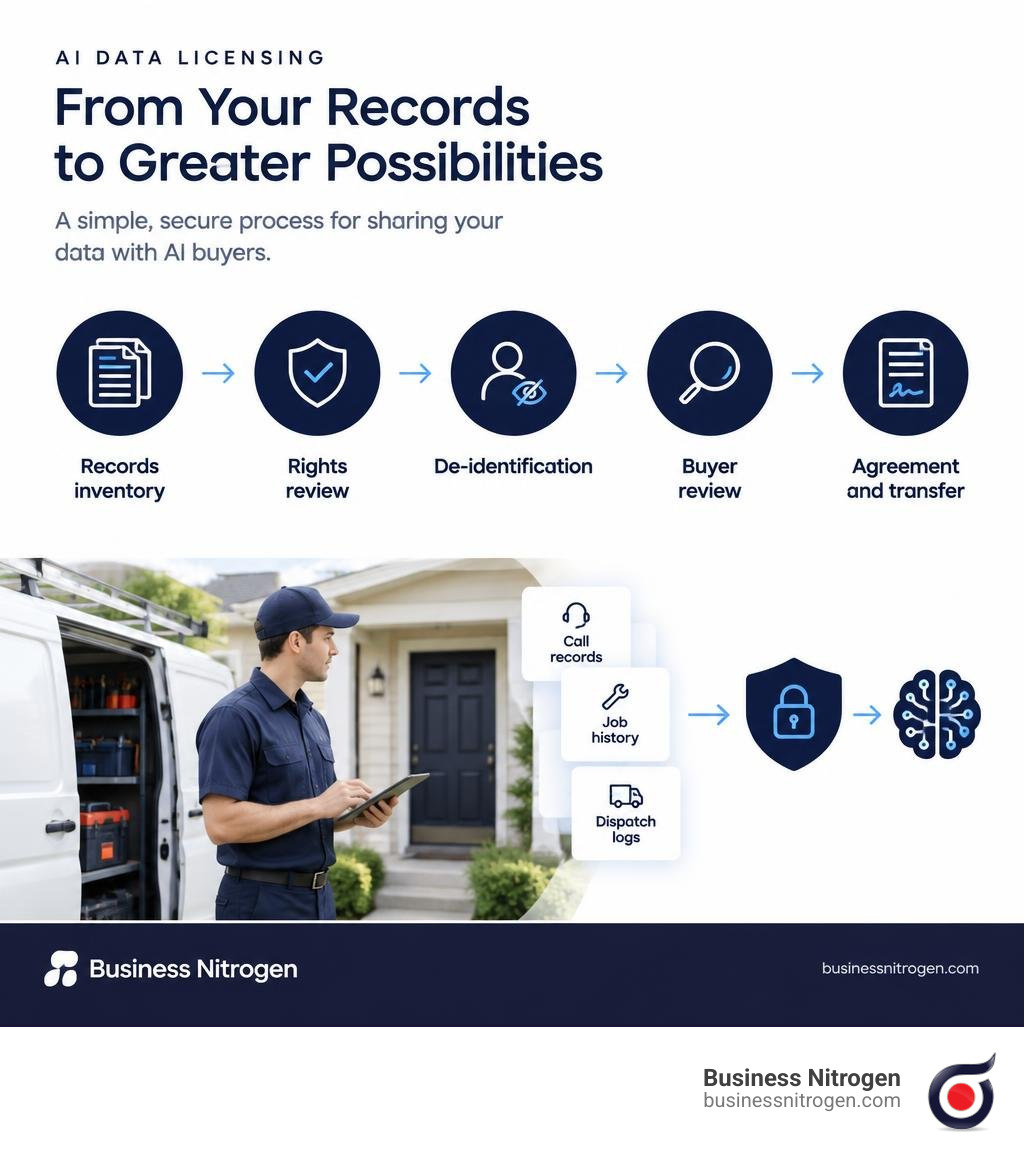
What does AI data licensing for home services companies involve?
At its core, a data license is a commercial contract where you grant a ai developer permission to use a sanitized, defined-use copy of your historical business files. You retain complete ownership of your company, your operations, and your original databases. The AI developer receives limited rights to process the information strictly for model training, fine-tuning, or testing.
Understanding data provenance, meaning the clear chain of custody showing where records came from and confirming the legal right to license them, has become a top priority for developers. Rather than scraping uncontrolled data from the public internet, artificial intelligence labs seek out verified, real-world operational records. They evaluate scope, data quality, access controls, retention schedules, and deletion commitments before finalizing any arrangement.
| Consideration | AI Data License | Company Sale | Commercial Loan |
|---|---|---|---|
| Ownership | Retain 100% company and data ownership | Transfer equity or assets to buyer | Retain equity (pledge collateral) |
| Repayment | No repayment required | No repayment (equity transfer) | Principal plus interest required |
| Permitted Use | Strictly limited to agreed AI training uses | New owner controls all assets | Lender monitors loan covenants |
| Operational Impact | Business continues normal operations | Management and control change | Ongoing debt service obligations |
What does AI data licensing for home services companies allow a buyer to do?
A licensing agreement spells out exact permissions for the buyer. Typically, AI development teams use trades records to build specialized software tools:
- Dispatch Agents: Training models to evaluate incoming emergency calls, match equipment issues with technician certifications, and optimize daily routes.
- Quoting Models: Teaching algorithmic engines how skilled estimators price complex duct replacements, panel upgrades, or repiping jobs based on regional variables.
- Field-Tech Copilots: Powering diagnostic assistants that help junior technicians troubleshoot complex fault codes on unfamiliar heat pumps or tankless water heaters.
Agreements must define whether the buyer can generate derivative synthetic datasets, establish how long model weights can retain mathematical representations of the training inputs, and outline post-termination rights if the license expires.
What records can HVAC, plumbing, and electrical companies assess for licensing?
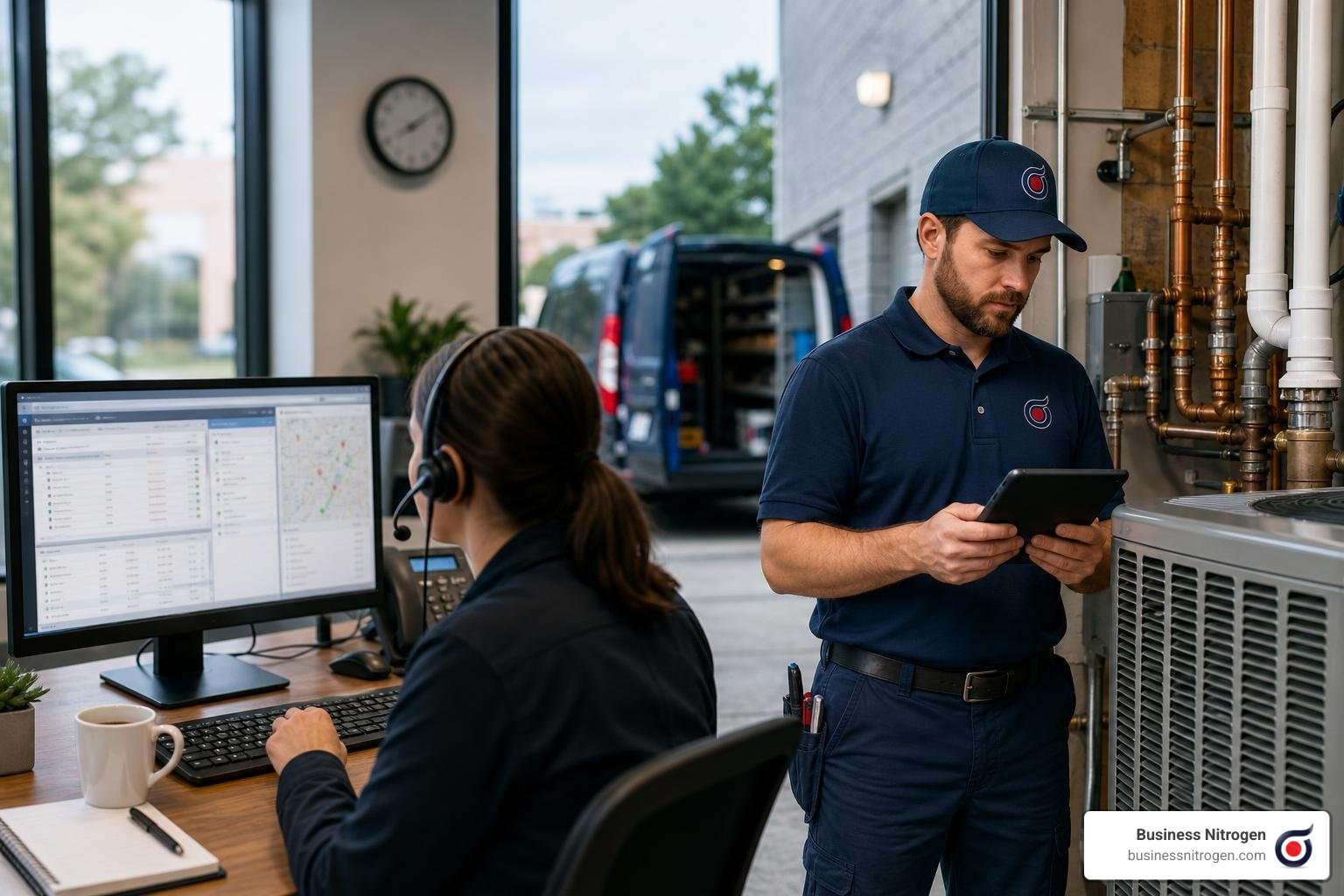
The true value of a trade business lies in its connected history across multiple systems. This spans work orders, dispatch logs, customer service representative scripts, consented call recordings, technician write-ups, diagnostic notes, repair outcomes, callback records, warranty claims, estimates, invoices, service club memberships, standard operating procedures, and safety checklists.
Connected operating history across email, calendars, documents, files, team chats, CRM platforms, and billing tools shows how an organization actually functions. Exploring AI training data licensing for Charlotte professional services firms highlights similar record-matching dynamics in other operational industries.
What records matter in AI data licensing for home services companies?
AI labs look for complete operational chains. A complete lead-to-cash record captures the customer request, the dispatcher’s decision, the technician’s action, the operational handoffs, the unexpected exceptions, and the ultimate outcome.
Decision pairs that connect a specific problem diagnosis to the exact parts used and the resulting fix provide deep learning value. Records displaying repair-or-replace presentations, customer selections, seasonal service swings, and warranty callbacks give AI models the context needed to understand skilled trades workflows. Even one well-documented workflow can offer strong utility if the records are consistent and complete.
How do AI teams use dispatch, call, and job records?
AI developers use operational records to train algorithms on real-world problem resolution. By evaluating thousands of scheduling choices, AI models learn how dispatchers juggle emergency calls against routine maintenance. By studying technician notes, language models learn trade terminology and physical diagnostic steps.
Consider an HVAC service workflow:
- Customer Request: A homeowner calls on a freezing morning reporting that their furnace blows cold air.
- Dispatch Decision: The dispatcher reviews technician skill levels, selects a senior furnace tech nearby, and adjusts the daily route.
- On-Site Diagnosis: The technician tests the unit, documents a cracked hot surface igniter, checks the flame sensor, and logs the part numbers.
- Option Presentation: The technician presents a repair quote alongside a preventative maintenance membership. The customer approves the repair.
- Outcome and Verification: The part is replaced, heat is restored, the invoice is closed, and the system records that no callback occurred over the following 60 days.
This sequence provides training signals that show an AI agent how customer communications, mechanical diagnosis, parts inventory, pricing, and job verification connect in the field.
What privacy, rights, and contract checks come before sharing records?
Protecting homeowner and employee privacy is the foundation of any data agreement. Before licensing data, trade companies must conduct a rigorous rights review covering data ownership, customer notices, commercial agreements, franchise restrictions, and home-warranty covenants.
Companies must review software terms of service to confirm they hold the authority to export and license records managed within their field management platforms. Call recordings require strict scrutiny under federal call-recording law and state wiretapping statutes, differentiating between one-party and all-party consent states. AI governance standards such as the EU AI Act require transparent data provenance, making legal oversight essential.
How should customer and technician information be de-identified or excluded?
Data sanitization must happen before any information is delivered to an AI buyer. All direct personal identifiers must be removed or generalized:
- Customer Identifiers: Remove customer names, street addresses, phone numbers, and email addresses. Replace individual identifiers with consistent pseudonyms (such as Customer 4402) to preserve workflow tracking across jobs without exposing identities.
- Geographic Data: Generalize precise street addresses to the city, county, or 3-digit ZIP prefix level.
- Technician Records: Replace technician names with generic codes (such as Tech 12). Strip out GPS tracking breadcrumbs, personal phone numbers, wage rates, and human resources files.
- Free-Text Scrubbing: Review customer notes and technician write-ups to eliminate gate access codes, alarm passwords, lockbox combinations, and equipment serial numbers that could link back to warranty registries.
| Action Category | Record Types | Handling Method |
|---|---|---|
| Remove | Credit card numbers, bank details, SSNs, passwords | Permanently delete from dataset |
| Generalize | Street addresses, precise timestamps, equipment serials | Convert to 3-digit ZIP, month/year, generic equipment class |
| Pseudonymize | Customer names, technician names, invoice numbers | Replace with persistent random tokens (e.g., Cust881, Tech04) |
| Review & Exclude | Free-text job notes, dispatch logs, customer voice calls | Screen for access codes, medical notes, or unconsented audio |
Which records need extra caution or should stay out?
Sensitive files must be left out entirely. Exclude payment card details, bank information, tax identification numbers, passwords, medical notes, and any data involving minors. Commercial client contracts containing strict non-disclosure agreements, proprietary vendor pricing matrices, and third-party copyrighted manuals must remain outside the scope.
Job photos require manual review. Photos displaying homeowner faces, house numbers, vehicle license plates, or home interiors must be excluded. Only clean photos focusing solely on mechanical equipment and wiring components should ever be considered.
What should the license say about use and security?
A comprehensive data licensing agreement must incorporate protective safeguards:
- Permitted Purpose: Explicitly limit usage to training, fine-tuning, and evaluating specific AI models, excluding general resale.
- Competitor Protections: Prohibit the buyer from licensing custom models directly to your immediate local competitors.
- Strict Anti-Re-Identification: Legally bar the buyer from attempting to re-identify any customer, property, or employee.
- No Customer Contact: Prohibit the buyer or any downstream user from contacting individuals appearing in historical records.
- Security and Encryption: Mandate end-to-end encryption in transit and at rest, alongside defined access controls and prompt breach notifications.
- Retention and Deletion: Establish a clear expiration date, post-termination rules, and certified destruction protocols for raw files.
How can an owner assess fit, value, and the licensing process?
Evaluating your company’s fit begins with a metadata-level inventory. This means creating a high-level summary of the systems you use, the categories of records you maintain, the approximate volume of completed jobs, and the number of years of historical records available.
During this exploratory stage, never share raw customer databases, internal job exports, or system login credentials. An initial evaluation requires only metadata descriptions to establish feasibility.
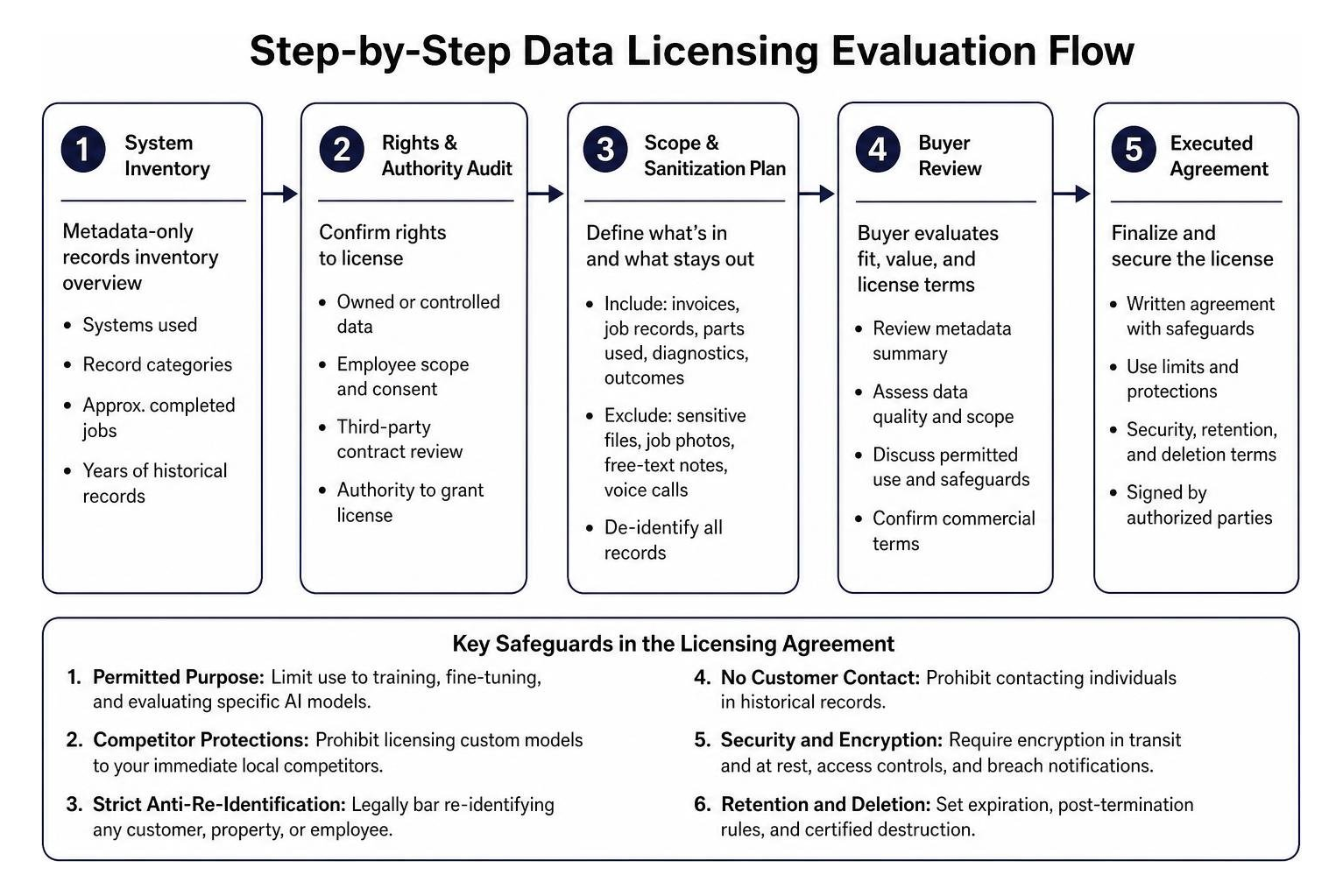
How do you assess fit for AI data licensing for home services companies?
AI buyers prioritize established companies with consistent, multi-year operating histories in structured field management software. Organizations operating across multiple connected platforms, like CRM tools, field dispatch engines, cloud accounting, and automated communication hubs, generally present more complete operational context.
Employee headcount and operating years serve as general buyer-specific criteria rather than universal requirements. A firm with clean, highly detailed diagnostic notes and clear job outcomes across a single trade can often present strong training utility.
What is the typical licensing process?
The licensing journey follows a structured sequence:
- Metadata Inventory: Document your platforms, job volumes, trade specialties, and years of historical records.
- Rights Audit: Review software agreements, franchise terms, and privacy policies with counsel to verify data licensing authority.
- Scope Selection: Define which record categories, date ranges, and departments will be included or excluded.
- De-Identification Planning: Establish data sanitization protocols to remove personal data, sensitive pricing, and operational trade secrets.
- Buyer Evaluation: Present the sanitized metadata profile to prospective AI development labs under a mutual non-disclosure agreement.
- Contract Negotiation: Draft and refine the licensing agreement, ensuring robust protections regarding use limits, security, and deletion.
- Approved Transfer: Export the sanitized data package directly to the buyer’s secure cloud storage.
Timelines vary depending on technical complexity and legal review. Payout schedules and transaction completion times depend entirely on mutual agreement between the parties.
What affects a licensing estimate, and what should owners ask?
Licensing valuations are influenced by dataset completeness, trade variety, geographic diversity, note depth, and the clarity of decision-to-outcome linkages. A dataset pairing a diagnostic note with a verified repair and long-term callback tracking holds far higher utility than isolated invoicing spreadsheets.
Any estimate is an illustrative calculation, not a formal appraisal, buyer offer, or guarantee. Before entering into an agreement, owners should ask:
- What specific AI models will this data train, and who will have access to the final system?
- How will our customer, employee, and company identities be shielded from re-identification?
- Is this license exclusive, or do we retain the right to license sanitized copies to non-competing parties?
- What precise security protocols and encryption standards govern the storage and transfer of our files?
- What happens to fine-tuned model weights and raw training files when the contract terminates?
Frequently Asked Questions about AI Data Licensing for Home Services Companies
Does licensing mean selling the company or taking a loan?
No. Licensing data is neither a sale of your business nor a commercial financing vehicle. You are not taking on debt, pledging business assets, or relinquishing equity. You simply grant a limited, non-exclusive legal permission for an external party to use a processed copy of your historical operational records while your company continues operating normally.
Do we need to include customer names, addresses, calls, or photos?
No. AI models do not need individual customer identities to learn trades workflows. All customer names, street addresses, phone numbers, and payment details must be stripped or generalized before delivery. Call recordings and job photos can be left out of scope entirely if they do not meet strict consent standards or if they risk displaying private property interiors.
Is licensing income guaranteed, and what are the tax implications?
No licensing income, buyer offer, or evaluation outcome is ever guaranteed. Payouts depend on commercial demand, data quality, and negotiated terms. Licensing proceeds are typically treated as ordinary business income rather than capital gains. Always consult a certified public accountant and qualified legal counsel to evaluate your specific tax position and contractual rights before proceeding.
Conclusion
Operational data licensing offers established HVAC, plumbing, and electrical contractors an opportunity to evaluate their historical records as strategic commercial assets. By prioritizing data provenance, privacy safeguards, and strict contractual use limits, trades business owners can explore the AI economy on their own terms.
To explore how your company’s operational records align with current market interest, you can estimate my licensing value using our structured evaluation tools.
Business Nitrogen provides strategic and commercial support and is not a law firm. This page is educational and is not legal, tax, financial, privacy, security, or compliance advice. Calculator results are illustrative licensing estimates, not appraisals, buyer offers, or guarantees. Buyer demand, eligibility, timing, terms, and payment are not guaranteed. Consult qualified advisers before licensing or transferring data.